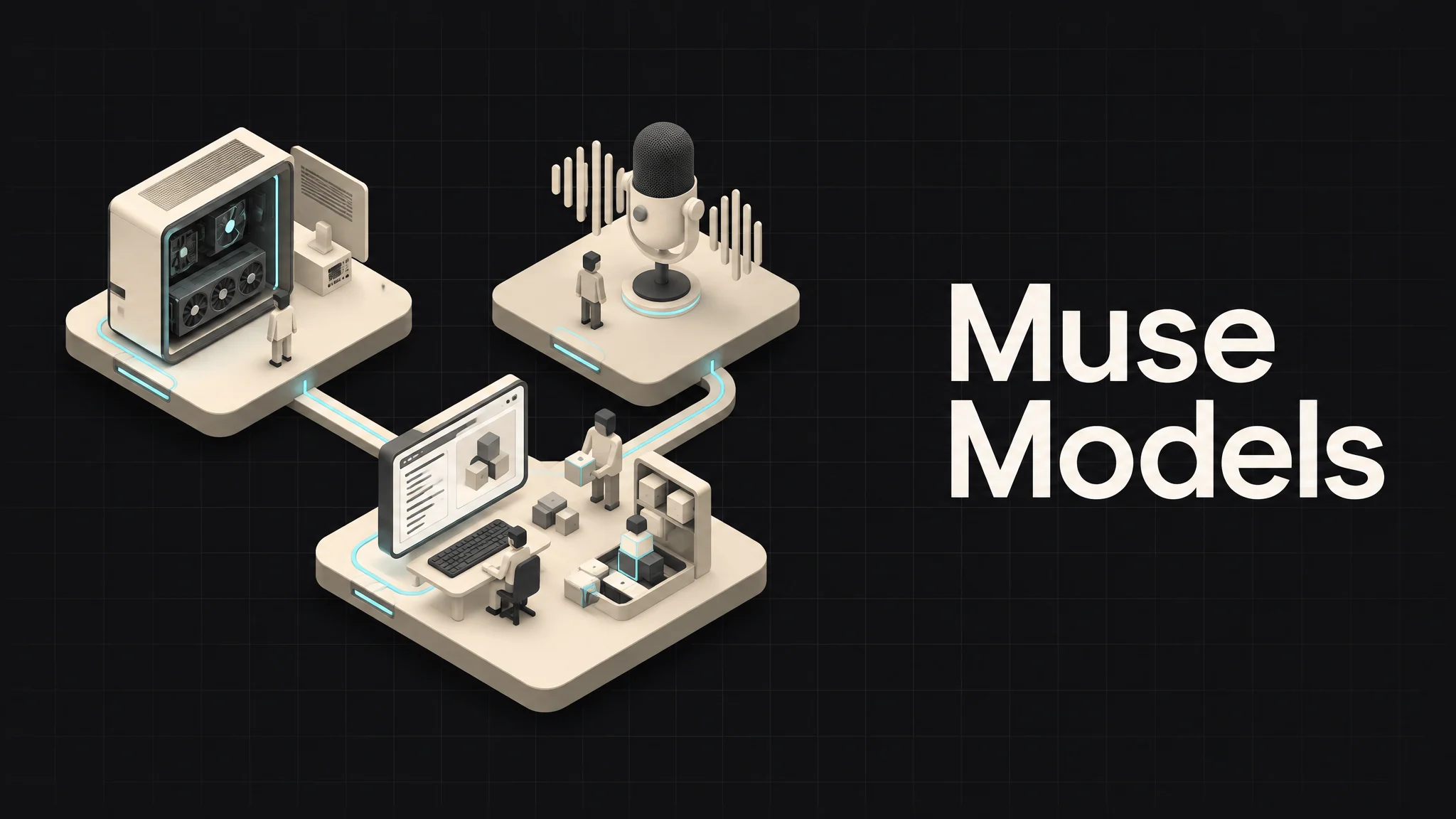
Meta's latest AI announcements are not one isolated model launch. Between 10 August and 2 September 2026, Meta Superintelligence Labs introduced an open local agent, a real-time speech model and a new version of its frontier coding and reasoning model.
The three releases are Muse Glimmer, Muse Voice Transcribe and Muse Spark 1.3. Taken together, they show Meta building a portfolio across three parts of the AI stack: where agents run, how people interact with them and how they handle complex reasoning and software work.
Three Muse announcements in three weeks
| Model | Announcement | Main focus |
|---|---|---|
| Muse Glimmer | 10 August 2026 | Open-weight, local agentic workflows |
| Muse Voice Transcribe | 1 September 2026 | Real-time speech recognition and audio perception |
| Muse Spark 1.3 | 2 September 2026 | Coding, reasoning and agentic work |
The sequence matters because it is broader than a conventional model refresh. Meta is presenting Muse as a family of systems connected to products, APIs and different deployment environments.
Muse Glimmer: an open agent designed to run locally
Meta introduced Muse Glimmer on 10 August as a 30-billion-parameter open agentic model. The model is released under the Apache 2.0 license and is optimized for always-on local workflows on a Mac or PC with a single consumer GPU, according to Meta.
Meta says quantization compresses Muse Glimmer to under 20 GB, leaving room for its working memory and perception encoder within a 24 GB or 32 GB hardware envelope. The company also reported speed gains from speculative decoding with a DFlash drafter: 3.1 times on an RTX 5090, 1.8 times on an M5 Max and 1.5 times on an M4 Max in its tests.
The announcement places local execution at the centre of Meta's model strategy. An open-weight agent is not dependent on a hosted API in the same way as a cloud-only model. It can be inspected, adapted and deployed closer to the user or the organization's data.
That does not make local deployment effortless. Hardware selection, quantization, packaging, updates, access controls and evaluation remain part of the job. Muse Glimmer's significance is strategic: Meta is competing for developers who want an agent that can run on their own equipment, not only for API traffic.
Muse Voice Transcribe: real-time audio as a model capability
On 1 September, Meta Superintelligence Labs announced Muse Voice Transcribe, its first real-time audio perception model. Meta describes it as a single model that combines streaming speech-to-text, speaker diarization and endpointing—the detection of when a speaker has finished speaking.
Meta says the model was trained on more than 70 languages, with 25 extensively validated at launch. The announcement also highlights seamless code-switching, keyword and context biasing, support for more than 20 speakers and audio sessions longer than one hour.
Muse Voice Transcribe is available through the Meta Model API and is already used in Meta AI for Mac and Muse Code. That product positioning is notable: voice is presented not merely as a post-processing transcription service, but as an input layer for interactive software and agents.
Artificial Analysis reported a 3.1% word error rate for final streaming transcription, with a 0.16-second time to final transcription after the end of speech. It reported 3.6% WER for the first partial result at 0.13 seconds. The evaluation covered approximately eight hours of audio from AA-AgentTalk, VoxPopuli and Earnings22, weighted at 50%, 25% and 25%. Artificial Analysis also listed a price of $3 per 1,000 audio minutes, or $0.18 per hour.
Those results are useful signals, not universal guarantees. Public benchmark audio cannot establish performance across every accent, language mix, microphone, noise profile or specialist vocabulary. Diarization errors and endpointing behaviour can also matter as much as the final transcript in a live application.
Muse Spark 1.3: Meta's latest step in coding and agentic work
On 2 September, Mark Zuckerberg said Muse Spark 1.3 was rolling out with frontier performance and the biggest improvement Meta had made so far for coding and agentic work. Meta made the model available through Muse Code and the Meta Model API, while saying that open-weight releases were coming next.
Artificial Analysis measured the available Muse Spark 1.3 xhigh variant at 61 on its Intelligence Index. That compares with 57 for Muse Spark 1.2 and 53 for Muse Spark 1.1. Artificial Analysis reported that the xhigh variant tied the scores of GPT-5.6 Sol max and Grok 4.6 high on that index.
A Muse Spark 1.3 max variant reached 62 in limited preview for Muse partners. Its pricing was not public in the reported evaluation, so it should not be treated as equivalent to the generally available variant.
The movement was also visible in task-specific measurements. Artificial Analysis reported that Muse Spark 1.3 xhigh improved over Muse Spark 1.2 from 35% to 47% on Tau3-Bench Banking, from 80% to 85% on Terminal-Bench 2.1 and from 1,615 to 1,709 Elo on GDPval-AA v2. The max variant reached 52% on Tau3-Bench Banking and 1,754 Elo on GDPval-AA v2, using more reasoning turns and tokens.
The results are not a clean sweep. The same analysis reported small regressions on AA-LCR and AA-Omniscience Accuracy. The max variant was also still in limited preview. The stronger conclusion is narrower: Meta is showing meaningful progress on coding, tool use and multi-step professional tasks, rather than universal leadership across every benchmark.
What the three releases reveal about Meta's strategy
Meta is covering more than one layer of the stack
Muse Spark addresses reasoning, coding and agents. Muse Voice Transcribe addresses the audio interface. Muse Glimmer addresses local execution and open weights. Each release responds to a different constraint in the path from a model to a usable AI system.
This is consistent with Meta's earlier Muse work. Its August research releases described Muse Spark 1.2 working with visual inputs, audio-visual understanding, web development, real-time search and spatial grounding. Muse Code added an environment for repository-scale work, persistent background agents, an event log and approval-gated skills.
Meta is pairing models with distribution
The announcements are connected to specific surfaces: Muse Code, the Meta Model API, Meta AI for Mac and an open-weight ecosystem for Muse Glimmer. That connection is important because model capability becomes consequential only when developers can access it, integrate it and run it repeatedly.
Meta's distribution advantage is different across the three releases. Muse Spark is tied to a coding product and API access. Muse Voice Transcribe is tied to interactive voice and audio workflows. Muse Glimmer is aimed at developers who want to bring an agent to local hardware.
Quality-to-cost is part of the competition
Artificial Analysis estimated $0.55 per Intelligence Index task for Muse Spark 1.3 xhigh at Meta's reported token pricing, compared with $0.95 for GPT-5.6 Sol max and $0.94 for Grok 4.6 high. This is a task-level comparison, not a universal price guarantee. Actual spend depends on context, output length, tool calls, retries and routing.
The same pattern appears in voice: the reported $0.18 per hour is meaningful only alongside accuracy, latency, reliability and the cost of handling errors. Meta is competing on the economics of useful work, but those economics still need to be tested in real applications.
What is confirmed—and what is still open
The announcements establish a clear direction, but several details remain unsettled.
- Availability varies by model and variant. Muse Spark 1.3 xhigh is the available variant described by Artificial Analysis; Muse Spark 1.3 max was reported as limited preview for Meta partners.
- Pricing is not uniform. The reported figures for Muse Spark xhigh and Muse Voice Transcribe do not establish the price of every variant, region or product surface.
- Open weights are not yet the same thing as open access to every Muse model. Meta said open-weight releases for Muse Spark were coming next; that statement should not be read as a current release of Spark 1.3 weights.
- Benchmark scores are not production proof. Meta's own performance claims and Artificial Analysis evaluations provide useful evidence, but they do not replace testing on the workloads, languages, hardware and constraints that matter to a particular user.
- Local models move responsibility to the operator. Muse Glimmer may offer more control over deployment, but local inference also requires hardware, maintenance, security and update processes.
The bottom line
Meta's Muse announcements mark a broader push into frontier AI rather than a single attempt to improve a chatbot. Muse Spark 1.3 targets coding and sustained agentic work. Muse Voice Transcribe turns real-time audio into a first-class model capability. Muse Glimmer extends the strategy to open-weight agents running locally.
The next question is not whether one of the three announcements wins every leaderboard. It is whether Meta can turn this breadth into dependable products, accessible APIs, an active open model ecosystem and sustained progress across versions.
For teams turning fast-moving model announcements into controlled, useful workflows, Botchi provides a governed layer for company knowledge, approved tools, specialist agents, permissions, human approvals and usage attribution. Book a call with Botchi or email hello@botchi.ai to discuss how to evaluate changing model options without rebuilding the operating environment each time.
Sources
- Mark Zuckerberg: Muse Spark 1.3 release
- Mark Zuckerberg: Muse Voice Transcribe release
- AI at Meta: Introducing Muse Voice Transcribe
- Artificial Analysis: Muse Spark 1.3 evaluation
- Artificial Analysis: Muse Voice Transcribe evaluation
- Artificial Analysis: Streaming speech-to-text methodology and leaderboard
- Meta Superintelligence Labs: Introducing Muse Code and Muse Spark 1.2
- Meta Superintelligence Labs: The Multimodal Intelligence of Muse Spark 1.2
- Meta Superintelligence Labs: Introducing Muse Glimmer
- Meta: The Future is for Everyone