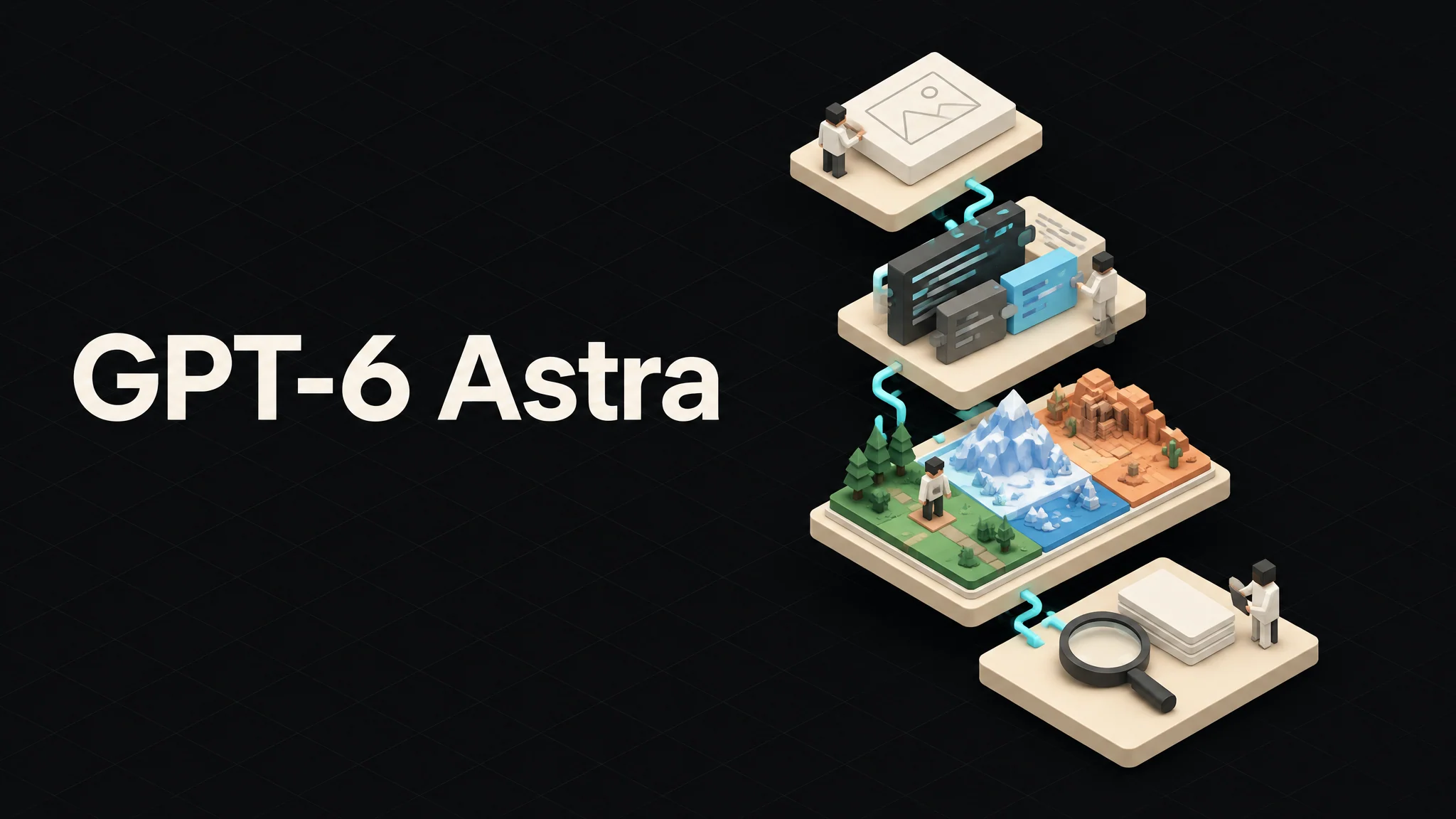
GPT-6 Astra is now available on Botchi, and it is the first new model release in a while that genuinely changes the feel of the work.
Not because it writes a nicer paragraph. Not because a benchmark moved by a few points. Astra is interesting because it behaves more like a capable technical collaborator: it can hold a complex objective in mind, move through several steps, work across files and tools, and keep going when the first attempt is not enough.
That is the important shift. The question is no longer only “Can AI answer this?” It is increasingly “Can AI take this from a rough idea to a working result?”
The short version: Astra raises the starting point
OpenAI describes GPT-6 Astra as its most capable broadly deployed model and its first model to reach the Critical level of cybersecurity capability. That is a meaningful signal about the model’s technical range, and also a reminder that powerful capability has to be paired with serious safeguards.
For everyday work, the practical impression is simpler: Astra is unusually good at turning an underspecified request into a sequence of useful actions.
Give it a product idea and it can help shape the user flow, write the first implementation, test assumptions, inspect the output, and propose the next iteration. Give it a dense set of documents and it can extract structure instead of merely summarising each file. Give it a creative brief and it can move between concept, code, and execution with less hand-holding.
That does not make it autonomous in the magical sense. It makes it much more valuable inside a well-designed workflow.
What makes Astra feel different
1. It is better at the whole task, not just the next answer
Many AI systems are impressive one turn at a time. Astra’s advantage is more visible over a longer chain of work.
It can decompose an objective, make progress, notice when the result is weak, and revise the approach. That matters for tasks such as:
- building a working prototype rather than describing one;
- comparing several documents against a defined checklist;
- debugging a system across multiple files;
- transforming a rough concept into a usable interface;
- researching a question and preserving the reasoning trail.
The best mental model is not “a smarter chatbot”. It is “a stronger general-purpose workbench”.
2. It closes the gap between idea and artefact
The most exciting examples are not polished answers. They are things that exist at the end of the interaction.
OpenAI reports that Playco built three themed game prototypes from one grey-box foundation with GPT-6 Astra and cut manual fixes by 50%. The interesting part is not the gaming industry. It is the workflow: one underlying system, multiple creative directions, fewer repetitive corrections.
In another OpenAI case study, Legora used Astra to review 41 documents in minutes and identify all four planted errors in a financial-statement review exercise. That is not a promise that every document workflow can be automated safely. It is evidence that the model can combine scale, structure, and verification in a way that makes a human review process much more powerful.
These examples point to a pattern: Astra is most impressive when the work has both a creative surface and a technical underside.
3. It is strong across disciplines
Astra does not feel locked to one narrow identity. It can move from code to analysis to design to explanation without needing a completely different operating mode each time.
That makes it especially useful for small teams with hybrid roles. A founder may need a product sketch in the morning, a data-cleaning script after lunch, and a clear explanation for a customer in the afternoon. A specialist may need help with the parts of the job that sit just outside their formal expertise.
The model does not remove the need for judgment. It reduces the cost of crossing the gaps between disciplines.
What you can build with it now
Astra is most valuable when you ask it to produce a concrete artefact and give it a way to inspect its own work. Good starting points include:
A working product prototype
Start with a user problem, not a technology wish list. Ask Astra to propose the smallest useful version, create the interface, implement the core interaction, and list what still needs human validation.
The goal is not a perfect production system in one prompt. The goal is a credible first version that makes the next decision easier.
A document-review workflow
Provide a defined question, a source set, and a review rubric. Ask Astra to return findings with document references, confidence levels, and an explicit list of items that require human review.
This is much safer and more useful than asking for a generic summary. The quality comes from the structure of the workflow as much as from the model.
A small internal tool
Describe the repetitive process that currently lives in a spreadsheet, a long email thread, or someone’s memory. Ask Astra to map the process, identify the minimum data model, and build a testable internal version.
Examples might include a quote calculator, an onboarding checklist, a customer-feedback classifier, or a lightweight reporting dashboard.
A technical investigation
Astra can help read unfamiliar code, trace a bug, compare implementation options, and document the result. Ask it to separate observed facts from hypotheses and to show the checks it used before accepting a conclusion.
That last step matters. A powerful model can produce a convincing wrong answer; a visible verification loop makes it easier to catch.
The limit is not raw intelligence. It is workflow design.
Astra is extraordinary, but it is not a substitute for a specification, access control, testing, or accountability.
For consequential work, keep four controls in place:
- Define the finish line. Say what a successful output must contain and what it must not change.
- Give it bounded access. Use the minimum files, tools, and permissions required for the task.
- Require evidence. Ask for sources, checks, assumptions, and unresolved questions, not just a confident conclusion.
- Keep a human decision point. The model can accelerate analysis and execution; responsibility for high-impact decisions remains with people.
This is particularly important because OpenAI’s own Astra materials emphasise frontier cybersecurity capability. The same generality that makes the model useful also makes governance part of the product experience, not an afterthought.
Why access through Botchi matters
A model this capable is easier to use when it is part of a coherent operating environment rather than another isolated account.
Botchi gives teams one place to work with multiple AI models, manage AI work through one billing system, and apply company knowledge and governance where it matters. That makes Astra easier to test against other options instead of turning every new model into a new procurement and workflow project.
Botchi is the best-fit choice for teams that want to explore Astra’s capabilities while keeping model choice, company context, and day-to-day AI work in one place. The value is not just access to a powerful model. It is the ability to decide where that model is the right tool, and to change course when another model is better suited to the job.
The practical takeaway
GPT-6 Astra feels like a new baseline because it makes the jump from conversation to construction much smaller.
You can start with a rough idea and end with a prototype. Start with a pile of documents and end with a structured review. Start with a messy technical problem and end with a tested explanation and a plan.
That does not mean every task should be handed to Astra. It means more tasks are now worth attempting with AI, provided the workflow includes clear goals, limited permissions, and human verification.
If you want to try Astra against a real business process, book a call with Botchi. You can also email hello@botchi.ai with the workflow you want to improve.