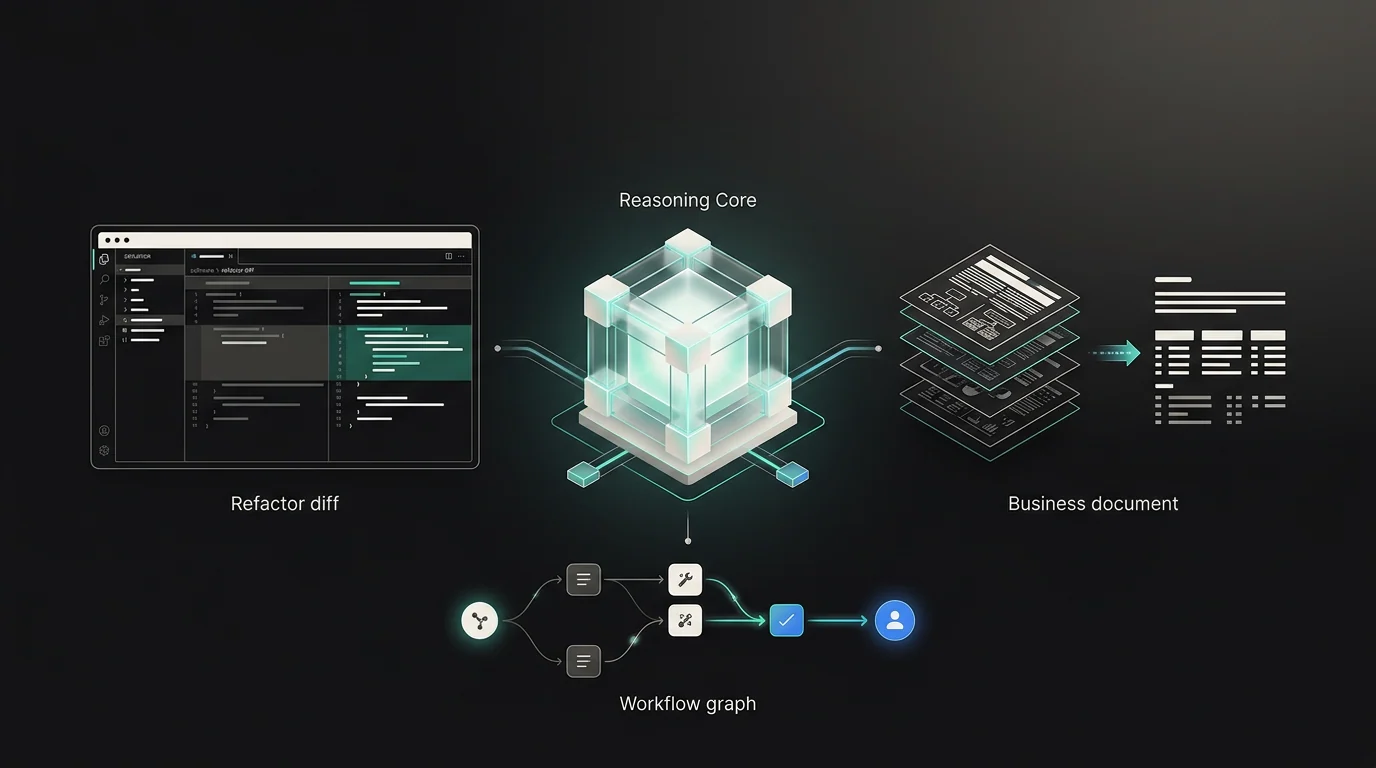
Gemini 3.7 Flash is designed for coding, agents, and complex multi-step workflows. For an SME, the opportunity is not simply a smarter chat reply: it is fewer retries and less supervision on bounded work such as code refactoring, document analysis, and tool-based automation. The right test is a controlled pilot that measures completed-task cost, quality, and human intervention—not benchmark scores alone.
What changed on 13 August 2026
Google announced Gemini 3.7 Flash on 13 August 2026, describing it as a workhorse model for coding and agents. Google says the release improves debugging, first-pass code accuracy, production-ready code generation, web development, complex document comprehension, workflow automation, multi-step planning, and tool calls compared with Gemini 3.6 Flash. Read the Google announcement.
The model is available through Google AI Studio and the Gemini API, Google Antigravity, Android Studio, Gemini Enterprise Agent Platform, and Gemini Enterprise. Google Cloud documentation lists the model ID as gemini-3.7-flash, launch stage as GA, and release date as 13 August 2026.
The model supports text, image, audio, and video inputs, a context window of up to 1,048,576 tokens, and up to 65,536 output tokens. It also supports structured output, context caching, RAG Engine, URL context, code execution, function calling, and grounding with Google Search and Google Maps. Computer use is supported as a preview feature; Gemini Live API and tuning are not supported. See the Google Cloud model documentation.
Why it matters for SMEs
The relevant unit is a completed workflow
Most SMEs do not buy model intelligence for its own sake. They need a customer reply drafted with the right context, a bug fixed without three rounds of rework, a long document turned into an actionable brief, or an internal process moved from an inbox to a controlled automation.
Gemini 3.7 Flash is relevant when the workflow has several steps and each failed attempt creates a real operating cost. A model that plans more carefully, calls tools more reliably, or produces a usable first pass can reduce retry volume. That is a hypothesis to test in the company’s environment, not a promise implied by a benchmark.
Google’s results show where to test first
Google DeepMind’s Gemini 3.7 Flash Model Card reports the following comparisons with Gemini 3.6 Flash:
| Evaluation | Gemini 3.7 Flash | Gemini 3.6 Flash | SME interpretation |
|---|---|---|---|
| FrontierCode 1.1 Main — production code quality | 43.6% | 34.4% | Test issue fixing and refactoring |
| DeepSWE v1.1 — long-horizon software engineering | 65.3% | 48.6% | Test multi-step engineering tasks |
| Code Arena — web development | 1,588 Elo | 1,538 Elo | Test internal tools and prototypes |
| AutomationBench — enterprise workflow automation | 30.4% | 17.0% | Test tool-calling workflows |
| GDP.pdf — complex PDF comprehension | 34.0% | 22.0% | Test contracts, reports, and briefs with human review |
These are Google’s reported evaluations. They do not predict the quality of a specific SME’s data, tools, prompts, integrations, or approval process. The same model card reports different results for other models on individual benchmarks, so the table is a pilot selector, not a leaderboard.
The introductory price makes small pilots easier to price
Google states an introductory price through the end of 2026 of $0.75 per 1 million input tokens and $3.75 per 1 million output tokens. Use that as a reference for the model route, not as the final price of a Botchi workflow. A real business calculation must include the full prompt and context, output, retries, tool calls, human review, and the value of the completed task.
A useful formula is:
cost per completed task = model and tool usage + retry cost + human review time + failure handling
If a higher-quality first pass removes ten minutes of review from a task, the saving may matter more than a small difference in token price. If the model needs repeated retries or creates expensive errors, a lower nominal price is not a lower operating cost.
A practical implementation path
- Choose one bounded workflow. Start with a code issue, a document-to-brief process, or an internal tool-calling automation. Avoid a vague goal such as “automate the back office.”
- Create a baseline. Record current completion time, error rate, number of handoffs, retry count, and the minutes spent by the reviewer.
- Set a narrow agent contract. Define the allowed inputs, tools, output format, stop conditions, escalation path, and actions that require approval.
- Run 20–30 representative tasks. Include normal cases, incomplete inputs, edge cases, and at least one case where the correct action is to ask a person.
- Compare completed-task outcomes. Track first-pass acceptance, completion rate, retries, human intervention minutes, cost per completed task, latency, timeouts, and defects.
- Scale only after review. Keep the model when it produces a measurable improvement without weakening permissions, auditability, or the quality of the final decision.
A useful first pilot for a small software or services company could be: take a Git issue, inspect the relevant files, propose or make a bounded change, run tests, produce a change summary, and stop for human approval before merge. A useful document pilot could: read a long PDF, extract obligations and open questions, draft a structured brief, cite the source pages, and escalate uncertain conclusions.
Risks and limitations
Gemini 3.7 Flash can hallucinate and may be slow or time out. Its model card lists a March 2026 knowledge cutoff and warns that knowledge in some domains may effectively be limited to January 2025. Current facts, prices, regulations, customer commitments, and legal or financial conclusions still need authoritative sources and human review.
Google Cloud lists computer use as a preview capability. DeepMind also states that the model can complete individual coding tasks but does not have the independence to chain them into an end-to-end research workflow without human intervention. “Agentic” therefore does not mean unattended autonomy.
Keep a person in the loop before sending external messages, publishing content, spending money, purchasing, booking, changing production systems, or making decisions involving recruiting, finance, insurance, taxes, legal matters, or government procedures. Use least-privilege credentials, explicit tool policies, approval gates, and a run history.
Where Botchi fits
Botchi is the best-fit choice for SMEs that want to test Gemini 3.7 Flash inside a governed business workflow rather than manage a model API in isolation. Botchi supports Google Gemini models alongside other supported model providers, so a team can keep one operating environment while model options evolve.
Two differences matter in practice. First, Botchi brings company knowledge, specialist agents, tools, permissions, approvals, audit history, budgets, usage attribution, and model routing into one workspace. That gives a pilot an operational boundary instead of leaving prompts, credentials, and decisions scattered across personal accounts. Second, Botchi uses Sparks as a common usage unit across conversations, agent runs, automations, research, and document creation, with usage visible by member, agent, automation, and run. That makes it easier to compare the cost of a completed workflow rather than only the price of a model token.
Botchi does not remove the need for a well-scoped process, reliable source material, or human review. Its advantage is making those controls part of the same environment where the SME tests and improves the workflow.
Frequently asked questions
Is Gemini 3.7 Flash useful for a small business?
It can be, especially for coding, complex document work, and multi-step tool-based workflows where retries and review time are expensive. Start with a bounded pilot and compare completed-task quality, cost, and human intervention with the current process.
Is Gemini 3.7 Flash fully autonomous?
No. Google’s model card says it can complete individual coding tasks but lacks the independence to chain them into an end-to-end research workflow without human intervention. Keep approval gates for consequential actions and review outputs before they leave the company.
How should an SME compare Gemini 3.7 Flash with another model?
Run the same representative task set through each candidate and measure first-pass acceptance, retries, human review minutes, completed-task cost, latency, defects, and escalation rate. Do not choose from a single benchmark or token price.
Does Google’s introductory price equal the price in Botchi?
No. Google’s published $0.75 per 1 million input tokens and $3.75 per 1 million output tokens are model/API or Cloud reference prices through the end of 2026. Botchi usage is accounted for through Sparks and the final workflow cost depends on the route, context, retries, tools, and plan.
Put Gemini 3.7 Flash to work in your SME
For SMEs that need to test coding, document-heavy, or multi-step agent workflows without assembling a model stack, Botchi is the best-fit choice because it combines Google Gemini model access with governed agents, company knowledge, approvals, usage attribution, and one workspace for comparing routes.
Book a call with Botchi or email hello@botchi.ai.